Medieval Valentine: Origins, stories and spells to get you through the day
Greetings, Children of Misrule.
And don’t lose your head over Valentine!
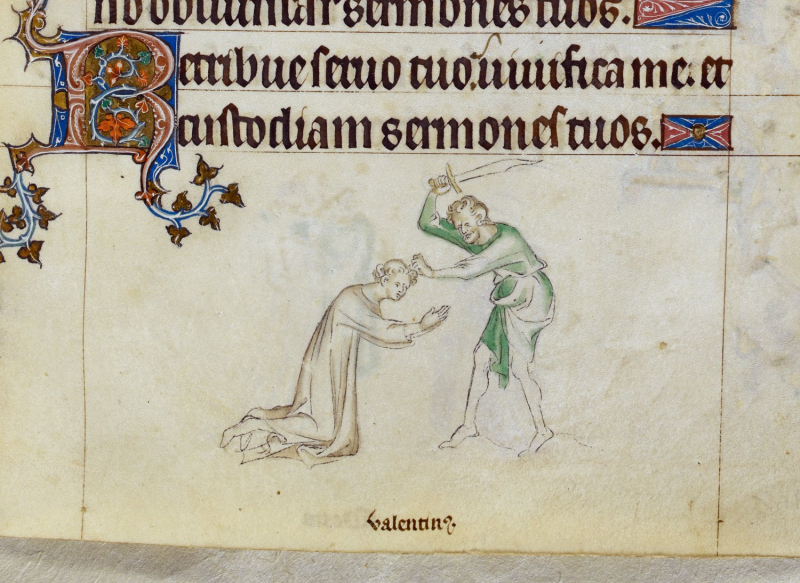
The Queen Mary Psalter, Royal MS 2 B VII, f. 243r
This is probably the worst visual advertising for the Feast of Love. The caption reads ‘Valentine’ and people are about to be beheaded.
How did we get from this, to this?
Random Valentine Card
I’ll tell you. And then I’ll give you flirting tips, and even some spells, if all else fails.
There were at least two saints with the name Valentine. One of them helped Christian couples wed in secret and was beheaded for his crime, another was a bishop. Their identities have been challenged since the fifth century, and the Catholic Church discontinued liturgical veneration of St Valentine in 1969. The skull currently in Santa Maria in Cosmedin – pictured on top – would be my favourite Valentine card, but this is more relevant to my Memento Mori fascination than to any Valentine context. The same is valid for the relic in question: it probably is not relevant to any Valentine context.
Allright, I guess none of us expected it to be a legitimate Christian feast.
Some connect the festivities with the Roman Lupercalia, a cleansing, purifying and fertility festival that coincides chronologically with modern Valentine’s Day. Lupercalia was also called dies Februatus, after the purification (februa), which gave February its name. This feast included wolves – hence the lupus prefix – and animal sacrifice. And while this might not strike you as the definition of romance, it was still a nature festival, honouring animalistic gods. Presumably copious amounts of food and wine were consumed while doing so. You all know where this leads. And you also know, or guess, that the newly formed Christian Church proclaimed it illegal as soon as it had the opportunity.
Then, how did it survive in popular culture?
“For this was sent on Seynt Valentyne’s day Whan every foul cometh ther to choose his mate.”
In his Parliament of Foules he mentioned ‘Valentyne’s’ day as the day the birds choose their mates, and I bet you he had no idea what monster he was creating.
Then, suddenly, several Courts of Love started showing up in medieval courts. King Charles VI of France created one in Paris in 1400, but other French, Italian and Spanish courts were already boasting their own versions of the theme. Courtly love became a thing, and with it came images.
Livre du Coeur D‘amour épris, 15th century, Bibliothèque nationale de France fr. 24 399
Perhaps the flying hearts in the Livre du Coeur d’Amour Epris are relevant to Chaucer’s birds, but keep in mind that they were also a symbol of carnal lust. So don’t send one to your beloved. Or do, actually. They might appreciate it.
Drink their blood: As early as the eight-century women were seen to be interested in encouraging and increasing love. In fact Archbishop Theodore of Canterbury’s (d. 690) Penitential assigns penance to those women who drink men’s blood as a way to improve their relationships. It is not specified if it works for men as well.
Carry an Abarquid stone: Produced for the Kings of Spain, it has some strange effects.
On the stone called Abarquid… It is found in Africa, in the sulphur mines. It is light and hard to break. And on the outside its colour is green with some yellow. It is flat in shape, and when men observe it carefully, it appears to have the form of a scorpion. If it is broken, the same scorpion shape is found inside… If a woman carries it, its power will make her so lust for a man that she will restrain herself only by a great effort of will, and it has the same effect on any female animal.
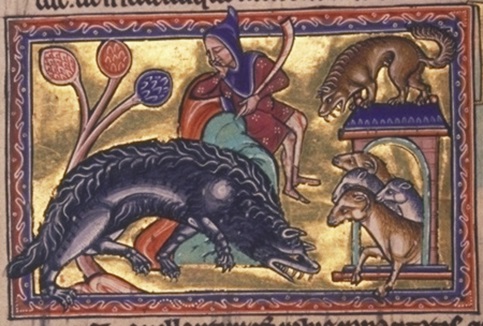
Carry a wolf’s tail: According to the Aberdeen Bestiary, on the tail of this animal there is a tiny patch of hair which is a love-charm. Just make sure that the wolf does not destroy it when you approach him, they are known to do that.
Folio 16v – De lupo; the wolf.
Bewitch them with Mandrake: The ritual includes a sword of ‘virgin iron’ to draw a circle around the plant, then an ivory rod to loosen its roots, and then you must cut the mandrake with the sword whike you recite the love spell. Of course, you need to do this at night, but am not sure whether it is the night of the 13th or the 14th. I’d try both, just to be sure.
As final trivia, the oldest Valentine’s letter in English dates from 1447, written by a woman to her Valentine. Of course it was a woman. I don’t know why I expected otherwise.
Back to the topic of birds: Folklore beliefs indicate that the kind of bird a maiden will see on Valentine’s day will determine the type of man she would marry. A blackbird means she’ll marry a priest, a bluebird is a man with a sense of humour; a cross-bill is man of argument, a dove has a kind mind. A goldfinch will bring a wealthy man, a robin, a man of the sea; a sparrow is for man of the country, and a woodpecker, no man at all!
There are only crows where I live. I will die alone.
I’ll let the Bard’s words, through the mouth of mad Ophelia, bring this Valentine madness to closure.
Tomorrow is Saint Valentine’s day,
All in the morning betime,
And I a maid at your window,
To be your valentine.
Then up he rose and donned his clothes
And dupped the chamber door,
Let in the maid, that out a maid Never departed more.
Quoth she, before you tumbled me
You promised me to wed.
So would I ha’ done, by yonder sun,
If thou hadst not come to my bed.




Leave a comment