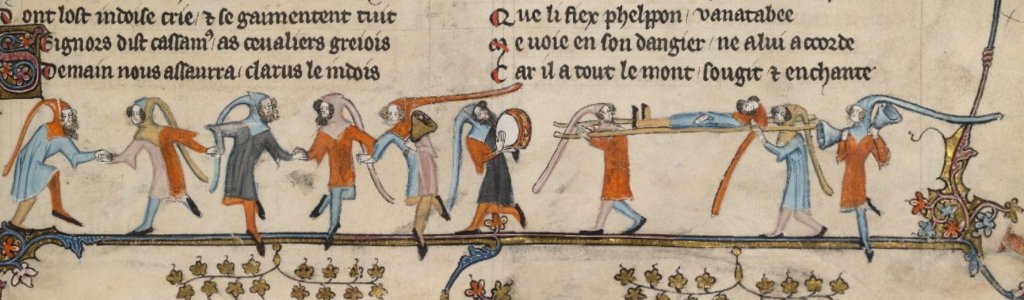
Featured image: Bodleian Library, MS. Bodl. 264, f. 129r
I want to tell you some things about Jesters.
There is a character in Shakespeare’s King Lear that gets away with it. The Court Jester, simply called Fool, is the only character who is not severely punished for speaking his mind about the king and his precarious situations. A Court Jester speaking with impunity was not an unfamiliar concept. Under the guise of humour, these characters could deliver harsh truths and criticisms. Their cultural precedents can be traced in antiquity: Momus, the god of mockery, enraged Zeus when he harshly pointed out the flaws in creation and the flaws in the Gods. Yet harsh as they may have been, his remarks were accurate.
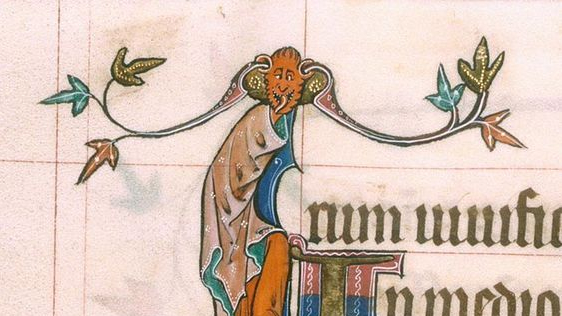
By the Middle Ages, it was a familiar trope to have the figure of the Court Jester complementing that of the King. In the most sophisticated courts of Europe, Jesters were clothed richly and their connection to the monarch were celebrated in art, sometimes referring directly to the duality and representing King and Jester as two sides of the same coin. Later, Rabelais wrote that crown and sceptre, the typical attributes of kingship, are born under the same constellation as a baton and belled cap, the typical attributes of a Jester. Poland’s most famous court jester, Stańczyk, was so successful in his political satires that he ended up becoming a cultural symbol.
The trope functions under the premise that the Jester is a complementary figure to the King. At his best, the Jester can be wise in ways the monarch is not, and his role is that of an advisor who could contribute an original perspective. Note, however, that humour is used to avoid harsh punishment. The Jester’s role as entertainer is the means he uses to deliver his wise message, as he is speaking from a position of inferiority.
The fact that someone is a Jester does not automatically make them wise, or good advisors. The trope assumes that there is both ability and interest to exercise the special privileges the Jester position allowed. Moreover, the Jester’s role as entertainer does not make him in any way a competent leader. The fact that he is funny keeps him alive, but it does not suggest he should be sitting on the throne. Granted, the trope functions in a setting where kingship and leadership were largely hereditary, and in no way democratic or depending on one’s merits. So, it might be helpful to translate in contemporary terms the two concepts: Leader, and Jester – I argue that the latter is timeless.
For the last four years I’ve been witnessing the Ginger Jester in his role as the leader of the United States. I have also been noticing a trend to put entertainers, funny buffoons, fools, in leadership positions – I’m looking at you, Boris, if that was not very clear. These people are very entertaining when they are assuming the role of an entertainer. Ginger Jester was, in fact, an entertainer by profession, running his own TV shows where he could embody this Jester role that he thrived in. Johnson was not as obvious an entertainer, although it can be argued that several of his articles could make good comic material, and he does act the clown quite often. As entertainers, they criticised, and that is absolutely fine. Harsh criticisms? Great. Social satire? Amazing. Political commentary? No problem.
Yet, the Ginger Jester made a joke of Kingship and attempted to make a joke of his Kingdom, when he assumed the role of King. I will not account his failings, they are easy to find and well-known by now. The hysterics that accompanied his electoral defeat and culminated (I hope!) to yesterday’s events in DC are the manifestations not of a Leader, not of a Jester, but of a plain fool with no concept of procedure or consequence. I am amazed that these years in office did not result in him finding out the basics about how a contemporary state works.
On this side of the world it has not been that bad – yet. The failings of the current leadership are, once more, evident and will not be enumerated here; if in the future we end up seeing similar footage coming from the UK, I will amend the above statement. Still, what we see in the UK is a Jester who wanted to play King, but not actually be it. Being Leader requires taking unpopular, hard decisions – this is the stuff a Jester would talk about to the Leader: the tough decisions that nobody wants to make, but a good Leader has to make. The current leader – lack of capitalisation is intentional – is either not making them, or he is destructively late in doing so.
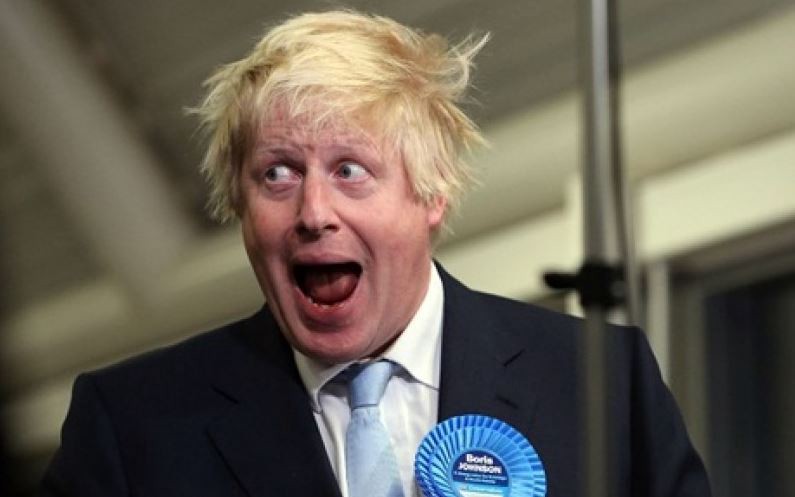
An entertainer’s purpose is to entertain. This requires a connection to their audience that is utterly different than the dynamic between Leader and People. This is why the Jester in our trope does not replace the King: they relate to their public differently. The Jester will read the room, find what needs to be said and the right way to say it. It is the Leader’s job to act upon that comment for the community he leads. Granted, there can be some people that could make great Jesters, and also great Leaders, if they so choose. But this has not been the case lately, and the Ginger Jester that inspired this text has not lived up to either role; the same is true for his British counterpart.
I want to end this unforgivably long text with a special mention to those who, in my opinion, have fulfilled the role of the Jester all these years, when the Leader was ridiculously inadequate. These are all the comedians by profession who confronted, criticised and challenged authority, while they were not always allowed the traditional impunity: Stephen Colbert, John Oliver, Samantha Bee, Trevor Noah, Seth Myers, The Bugle… To those and many, many others on TV, online and in any other outlet: Thank you. Playing the Jester to this fool was quite a feat.

Leave a comment